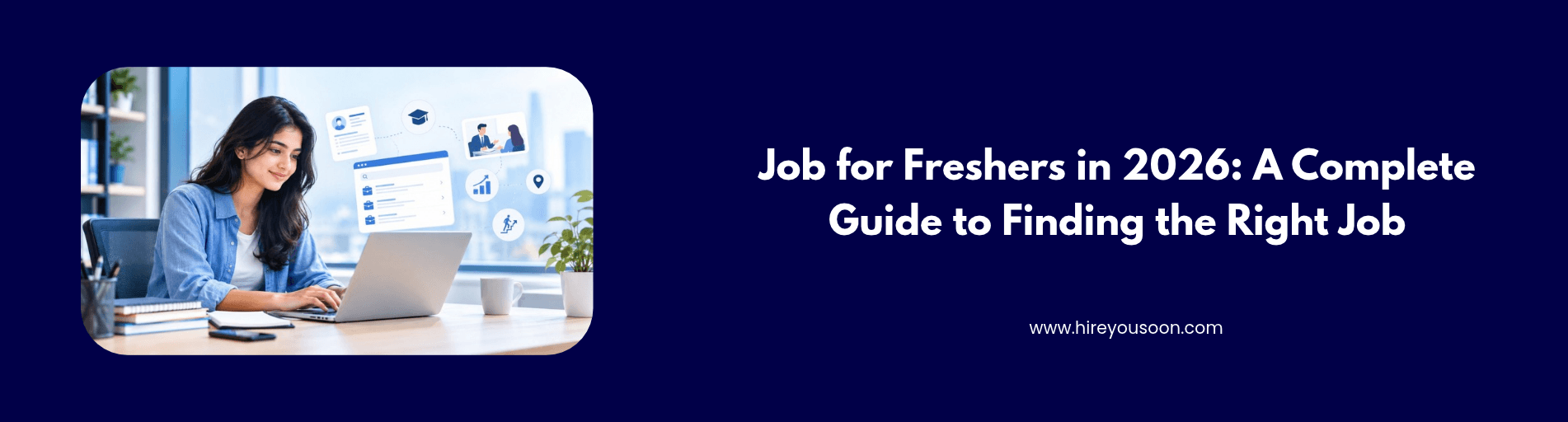
Job for Freshers in 2026: A Complete Guide to Finding the Right Job
 Adhil Padikka
October 13, 2026

 Adhil Padikka
 September 22, 2026
 8 mins to read
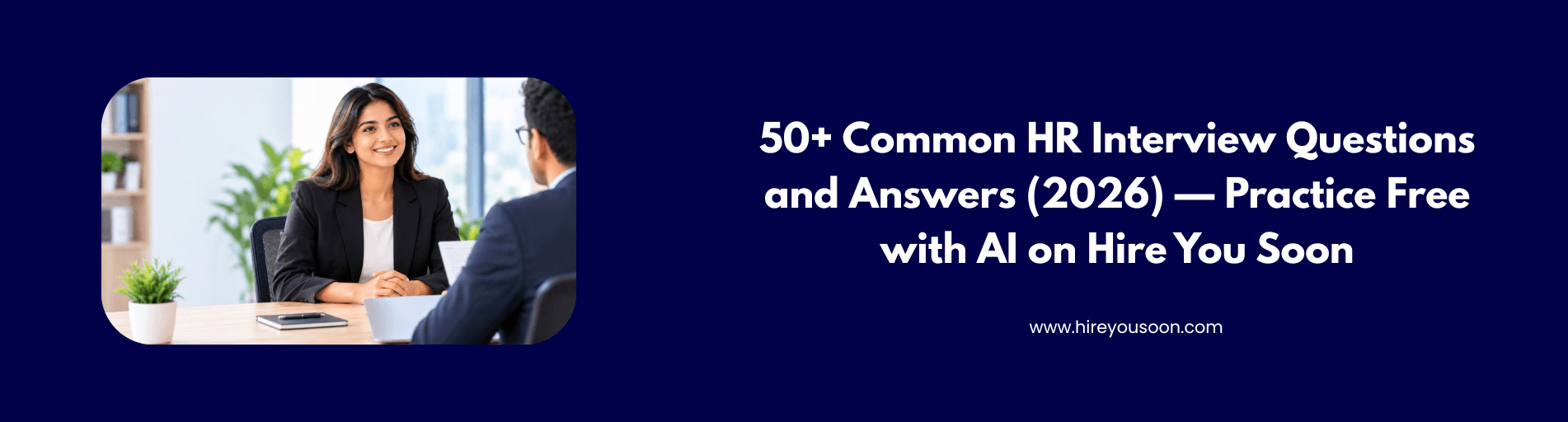
Preparing for an HR interview in 2026? Whether you are a fresher, an experienced professional, or someone switching careers, knowing how to answer common HR interview questions can make your interview experience much easier.
HR interviews are not only about your qualifications. Recruiters often use them to understand your communication skills, attitude, career goals, problem-solving approach, teamwork, adaptability, and overall suitability for the role.
In this guide, we cover 50+ common HR interview questions and sample answers for 2026, along with practical tips to help you prepare confidently.
You can also use Hire You Soon to explore career opportunities and practice your interview preparation with AI-powered career tools. Hire You Soon connects candidates with employers and provides job-search and recruitment features for the Indian market.
A strong resume may help you get shortlisted, but the interview is where you demonstrate how you communicate and present yourself.
Good preparation can help you:
The goal isn’t to memorize every answer. Instead, understand the structure behind a good answer and adapt it to your own experience.
Sample Answer:
“I’m a motivated professional with experience and interest in [your field]. I have developed skills in [2–3 relevant skills] through my education, projects, and practical experience. I enjoy learning new things and solving problems, and I’m now looking for an opportunity where I can contribute to a team while continuing to develop professionally.”
Tip: Keep your answer focused on your education, experience, skills, and career direction.
Sample Answer:
“I’m interested in your company because of its work in [industry/product/service]. The role matches my skills and career interests, and I believe I can contribute while learning from the team and gaining valuable professional experience.”
Tip: Research the company before the interview.
Sample Answer:
“My skills, willingness to learn, and ability to adapt make me a strong candidate for this role. I’m committed to delivering quality work, collaborating with the team, and continuously improving my skills.”
Sample Answer:
“My key strengths are communication, adaptability, problem-solving, and willingness to learn. I’m also comfortable taking responsibility and working toward deadlines.”
Tip: Mention strengths that are relevant to the job.
Sample Answer:
“I sometimes spend extra time making sure my work is accurate. I’ve been improving this by prioritizing tasks, setting deadlines for myself, and focusing on both quality and efficiency.”
Tip: Choose a genuine but manageable weakness and explain how you are improving it.
Sample Answer:
“In five years, I would like to have developed strong expertise in my field, taken on greater responsibilities, and contributed meaningfully to the organization. I also want to continue learning and growing professionally.”
Sample Answer:
“I’m looking for an opportunity that offers new challenges, professional growth, and the chance to use and develop my skills in a more meaningful way.”
Tip: Avoid criticizing your previous employer.
Sample Answer:
“I’m grateful for the experience I gained in my previous role. I decided to look for a new opportunity because I want to take on new challenges and continue developing my career.”
Sample Answer:
“I’m motivated by learning new skills, solving problems, achieving measurable results, and seeing the impact of my work.”
Sample Answer:
“Based on the responsibilities of the role and my skills and experience, I’m looking for a fair and competitive package. I’m also open to discussing the company’s salary range for this position.”
Sample Answer:
“Yes, I’m open to relocation if the opportunity and role are a good fit. I’d be happy to discuss the location requirements.”
Sample Answer:
“I understand that there may be situations where additional hours are required to meet important deadlines. I’m willing to be flexible when necessary.”
Sample Answer:
“Yes. I try to stay organized, prioritize tasks, and focus on solutions rather than becoming overwhelmed by pressure.”
Sample Answer:
“I break larger tasks into smaller steps, prioritize them according to urgency, and track my progress to make sure the work is completed on time.”
Sample Answer:
“I see constructive criticism as an opportunity to improve. I listen carefully, understand what needs to change, and try to apply the feedback to my future work.”
Sample Answer:
“I try to understand what caused the failure, identify what I could have done differently, and use that experience to improve my approach next time.”
Sample Answer:
“I would first try to understand the other person’s perspective and discuss the issue calmly. My focus would be on finding a practical solution rather than making the situation personal.”
Sample Answer:
“I’m comfortable with both. I can take ownership of individual tasks, but I also enjoy collaborating with colleagues when a project requires different skills and perspectives.”
Sample Answer:
“I communicate clearly, respect other people’s ideas, take responsibility for my work, and support teammates when they need help.”
Sample Answer:
“I prioritize tasks based on urgency, importance, deadlines, and their impact on larger projects. I then create a clear plan and adjust it when priorities change.”
Sample Answer:
“One of my proudest achievements was [describe your project or accomplishment]. I was responsible for [your responsibility], and the result was [specific outcome].”
Tip: Use numbers whenever possible.
Sample Answer:
“I worked on a project where we faced [challenge]. I helped by [action], worked with the team to solve the issue, and ultimately achieved [result]. The experience taught me the importance of planning and communication.”
Sample Answer:
“During a project, I made a mistake involving [brief explanation]. Once I identified it, I corrected the issue and reviewed my process to prevent it from happening again.”
Sample Answer:
“During [project/situation], I took responsibility for coordinating tasks, communicating with team members, and making sure we stayed on schedule. The experience helped me develop my leadership and communication skills.”
Sample Answer:
“I organize my tasks according to priority and deadline. I focus on completing high-impact tasks first while keeping track of the remaining work.”
Sample Answer:
“I understand that your company operates in [industry] and focuses on [product/service]. I also researched your recent work and company culture, which increased my interest in this opportunity.”
Tip: Always research the company before the interview.
Sample Answer:
“I chose this career because I’m interested in [field] and enjoy working on [relevant activities]. Over time, my education and practical experience have strengthened my interest in this area.”
Sample Answer:
“My short-term goal is to develop strong practical experience in this role. In the long term, I want to become an experienced professional who can take on greater responsibilities and contribute to important projects.”
Sample Answer:
“My short-term goal is to understand the role thoroughly, develop my technical and professional skills, and contribute effectively to the team.”
Sample Answer:
“My long-term goal is to build deep expertise in my field, take on leadership responsibilities, and contribute to the growth of the organization.”
Sample Answer:
“I’m comfortable learning new tools and processes. I usually start by understanding the fundamentals, practice them through real tasks, and ask questions whenever clarification is needed.”
Sample Answer:
“I follow industry developments, take online courses, practice new tools, read relevant resources, and work on practical projects whenever possible.”
Sample Answer:
“I work well with managers who provide clear expectations, constructive feedback, and enough independence to take ownership of my responsibilities.”
Sample Answer:
“I prefer a professional and collaborative environment where people communicate openly, support each other, and focus on achieving clear goals.”
Sample Answer:
“I believe my previous manager would describe me as responsible, dependable, willing to learn, and committed to completing my work properly.”
Sample Answer:
“I would respectfully explain my perspective and provide the reasoning behind it. Ultimately, I would respect the manager’s decision and focus on delivering the required result.”
Sample Answer:
“I stay focused on the most important tasks, break the work into manageable steps, communicate early if there are risks, and make sure critical deliverables are completed on time.”
Sample Answer:
“I would first try to understand the problem and research possible solutions. If I still needed help, I would ask an experienced colleague or manager specific questions rather than guessing.”
Sample Answer:
“I understand that every role includes routine responsibilities. I stay focused on accuracy and look for ways to improve efficiency without compromising quality.”
Sample Answer:
“I bring a combination of relevant skills, willingness to learn, adaptability, and a strong commitment to improving. I also focus on taking ownership rather than waiting for someone else to solve problems.”
Sample Answer:
“Yes. Feedback helps me understand where I can improve. I prefer clear and constructive feedback because it allows me to make measurable improvements.”
Sample Answer:
“I manage stress by staying organized, prioritizing tasks, communicating clearly, and focusing on what I can control.”
Sample Answer:
“I would take responsibility, inform the appropriate person, help correct the issue, and identify what caused the mistake so I can prevent it from happening again.”
Sample Answer:
“Yes. I’d like to know more about the team I would be working with, the key responsibilities during the first few months, and how success is measured in this position.”
Tip: Always prepare 2–3 questions for the interviewer.
Sample Answer:
“If the role requires experience with a specific tool that I haven’t used yet, that could be a current gap. However, I’m comfortable learning new technologies and have a track record of adapting quickly.”
Sample Answer:
“One challenge I have worked on is improving [specific skill]. I recognized the gap and started practicing through [course/project/experience], which has helped me become more confident.”
Sample Answer:
“I would listen carefully, understand the customer’s concern, remain professional, and focus on finding a practical solution within company policies.”
Sample Answer:
“I would first speak with them privately to understand if there is a genuine issue. If the problem affected the project and could not be resolved, I would communicate the situation appropriately to the team lead.”
Sample Answer:
“I’m looking for an opportunity where I can contribute to the organization, develop my skills, work with experienced professionals, and take on increasing responsibility over time.”
Sample Answer:
“I’m available to join [immediately/after my notice period]. I can coordinate the joining date based on the company’s requirements.”
Here are some additional questions you may encounter:
Explain something meaningful that demonstrates genuine interest and relevant qualities.
Choose a real situation and explain what you learned from it.
Explain how you reassess deadlines and adjust your plan.
Talk about learning the role, understanding expectations, meeting the team, and contributing to early tasks.
Focus on communication, clear expectations, feedback, and professional development.
For behavioral questions, the STAR method can help you structure your response.
Explain the situation briefly.
Describe your responsibility.
Explain exactly what you did.
Explain what happened because of your actions.
Question: Tell me about a time you solved a difficult problem.
Answer:
Situation: “Our project was falling behind schedule because of a technical issue.”
Task: “I was responsible for helping the team identify the cause.”
Action: “I reviewed the process, discussed the issue with the technical team, and helped implement an alternative solution.”
Result: “We resolved the issue and completed the remaining work within the revised deadline.”
This structure makes your answer clear, specific, and easy for the interviewer to follow.
Even a strong candidate can make mistakes during an interview. Avoid these common problems:
Interviewers want to hear your genuine experience. Use sample answers as frameworks rather than scripts.
Keep your answers professional and focus on what you learned.
Try to answer the question directly and provide relevant examples.
Understanding the organization, role, industry, and job description can help you provide more relevant answers.
Everything on your resume should be something you can confidently discuss.
Prepare a few thoughtful questions for the interviewer.
Compensation matters, but demonstrate interest in the role, responsibilities, learning opportunities, and organization as well.
A practical preparation routine can look like this:
Step 1: Read the job description carefully.
Step 2: Research the company and role.
Step 3: Identify the skills mentioned in the job description.
Step 4: Prepare your “Tell me about yourself” answer.
Step 5: Prepare examples using the STAR method.
Step 6: Practice common HR questions aloud.
Step 7: Conduct mock interviews.
Step 8: Review your resume before the interview.
Step 9: Prepare questions to ask the interviewer.
Step 10: Practice until your answers sound natural rather than memorized.
Reading interview questions is useful, but practice is what helps you become comfortable answering them.
Hire You Soon is an AI-powered career platform designed to connect job seekers with relevant opportunities and employers. Candidates can create profiles, search for jobs, apply to opportunities, and build their career visibility.
Use AI practice to simulate interview situations, identify areas where your answers can improve, and become more comfortable explaining your skills and experience.
Practice. Improve. Get Hired.
HR interviews don’t have to be intimidating.
The most effective preparation is not memorizing 50 answers. It is understanding your own experience, knowing your strengths, studying the role, and practicing how to communicate your ideas clearly.
Use these 50+ HR interview questions and answers for 2026 as a preparation checklist. Customize every sample answer according to your education, experience, skills, achievements, and career goals.
The more you practice, the more naturally you can communicate during the actual interview.
Explore job opportunities, build your professional profile, and continue your career journey with Hire You Soon.
Your next opportunity could start with one interview — and that interview starts with preparation.
1. What are the most common HR interview questions?
Some of the most common questions include “Tell me about yourself,” “Why should we hire you?”, “What are your strengths and weaknesses?”, “Why do you want to join our company?”, and “Where do you see yourself in five years?”
2. How should freshers prepare for an HR interview?
Freshers should focus on their education, projects, internships, skills, achievements, career goals, and willingness to learn. Practicing common HR questions can also improve confidence.
3. What should I say when an interviewer asks about my weakness?
Choose a genuine but manageable weakness and explain what you are doing to improve it.
4. How long should an HR interview answer be?
Most answers should be concise and relevant. For behavioral questions, use a structured example such as the STAR method.
5. Should I memorize HR interview answers?
No. Understand the key points and practice expressing them naturally. Memorized answers can sound unnatural.
6. What questions should I ask the interviewer?
You can ask about the team, role expectations, company culture, success metrics, training, and what the first few months in the position may look like.
7. Can AI help with interview preparation?
Yes. AI can be used as a practice partner to simulate interview questions, help structure answers, and provide feedback. However, candidates should still use their own genuine experiences and information when preparing answers.
Adhil Padikka
Digital Marketer | SEO | AI Content Creation | Web & Social Media
Adhil Padikka is a Digital Marketer based in Kozhikode, Kerala, with a strong interest in SEO, content marketing, social media, AI-powered content creation, and digital strategy.
He is currently building practical industry experience through digital marketing projects, with hands-on exposure to SEO, keyword research, competitor analysis, content optimisation, social media marketing, website optimisation, and performance-focused digital strategies.
 Adhil PadikkaAdhil Padikka
 Adhil Padikka
 Adhil Padikka
 Adhil Padikka
 Adhil Padikka
 Adhil Padikka
 Adhil Padikka
 Adhil Padikka
 Adhil Padikka