Looking for the Best Career Portal in India? Here’s Why Candidates Pick Hire You Soon Portal First
 Aysha
Aysha September 1, 2026

 Aysha
Aysha  May 29, 2026
 8 mins to read
The world of work is changing faster than ever before. If you open any news channel, scroll through social media, or talk to professionals, one topic dominates the conversation: artificial intelligence. From automated systems to advanced predictive tools, AI is no longer a technology of the distant future. It is right here, inside our offices, laptops, and smartphones.
This rapid shift leaves millions of workers with urgent questions. Will a machine replace me? Is my skills package outdated? How exactly is this tech being integrated into daily tasks? More importantly, when we look at the question of AI in jobs, threat or opportunity, which side wins? For job seekers looking to navigate this uncharted territory, finding the right career path requires understanding these trends and using the best tools available, such as the game-changing job portal Hire You Soon.
In this comprehensive, optimized guide, we will break down everything you need to know about the current market landscape. We will look at real-world applications, explore the landscape of AI jobs in India, and reveal how you can stay ahead of the curve using simple words.
To understand the impact on your career, we must first simplify what artificial intelligence really means. In simple words, it refers to computer systems designed to mimic human intelligence. This includes learning from patterns, solving complex problems, understanding language, and making decisions.
The conversation exploded globally with the rise of generative technology. Companies like OpenAI introduced models that can write essays, write clean computer code, and generate artwork in seconds. Suddenly, tech tools shifted from being simple calculators to collaborative assistants. Instead of replacing raw human thought, they provide a springboard that changes how we execute daily work.
Perhaps the most visible version of this tech in our daily lives is the modern AI chatbot. Gone are the days when automated chat assistants gave unhelpful, pre-programmed responses. Today’s chatbots understand context, show empathy-like reasoning, and resolve customer issues instantly. This shift has altered entry-level roles across customer service, technical support, and data entry, creating a ripple effect across the entire employment ecosystem.
Many professionals ask: how is AI used in jobs without us even realizing it? The truth is, it is already integrated into almost every major sector. Let’s look at how different industries are using these tools to transform operations:
Pro Tip for Job Seekers: The goal is not to compete with technology, but to learn how to manage it. Employees who know how to use these tools efficiently are outperforming those who resist them.
This is the ultimate debate dividing the modern workforce. Let’s analyze both sides of the coin objectively to understand whether you should be worried or excited.
| The Threat Perspective (Challenges) | The Opportunity Perspective (Benefits) |
| Automation of repetitive, routine tasks like basic data entry and filing. | Elimination of boring tasks, freeing up time for strategic planning. |
| Skill gaps for professionals who do not update their tech knowledge. | Creation of brand-new job roles like Prompt Engineers and Data Auditors. |
| Initial displacement in traditional customer support sectors. | Massive growth in tech development, maintenance, and analytics roles. |
It’s natural to feel anxious when a software program can generate a monthly financial report or write a marketing email in five seconds. For roles that depend purely on repetitive data processing, filing, or basic transcription, automation does present a clear substitution risk. If a task can be mapped with standard rules, a machine will eventually do it faster and cheaper.
History shows us that every major technological revolution—from the steam engine to the internet—destroys old roles but creates far more valuable ones. Advanced automation acts as an efficiency multiplier. Taking away repetitive, mind-numbing administrative work, it allows human professionals to focus on what they do best: empathy, critical thinking, complex leadership, and emotional intelligence.
Furthermore, managing these technologies requires human oversight. We need people to train the models, check them for bias, secure the data, and apply the insights creatively. The opportunity lies in upskilling yourself to be the person who directs the machine.
If you are building a career in South Asia, the landscape is exceptionally bright. The market for AI jobs in India is expanding at an exponential rate. India has transformed from being the outsourcing back-office of the world into a premier global hub for advanced engineering and machine learning research.
Major tech cities like Bengaluru, Hyderabad, Pune, and Delhi-NCR are seeing a massive surge in job postings. Companies are actively hunting for professionals who understand machine learning algorithms, natural language processing, and data engineering. Thousands of positions remain open simply because employers cannot find talent with the right combination of practical skills and adaptability.
But the boom isn’t just for software engineers. Non-tech sectors across the country—such as retail, banking, logistics, and digital marketing—are looking for professionals who know how AI is used in jobs to optimize local supply chains and improve customer engagement.
To survive and thrive in this evolving environment, you need a clear action plan. Here are three simple steps to ensure you stay irreplaceable:
Now that you are ready to upgrade your career and dive into the market, there is a major obstacle you must face: the traditional job hunt process. Most job seekers spend hours tailoring their resumes, only to upload them into giant, outdated platforms where applications disappear into a black hole.
Ironically, old-school job portals use poorly designed, outdated algorithms to screen applicants. These systems look for exact keyword matches, filtering out highly creative, adaptable, and capable human candidates simply because their resumes lack a specific buzzword. This leaves job seekers frustrated and companies unable to find genuine talent.
Introducing Hire You Soon: The Ultimate Job Portal for the Modern Workforce
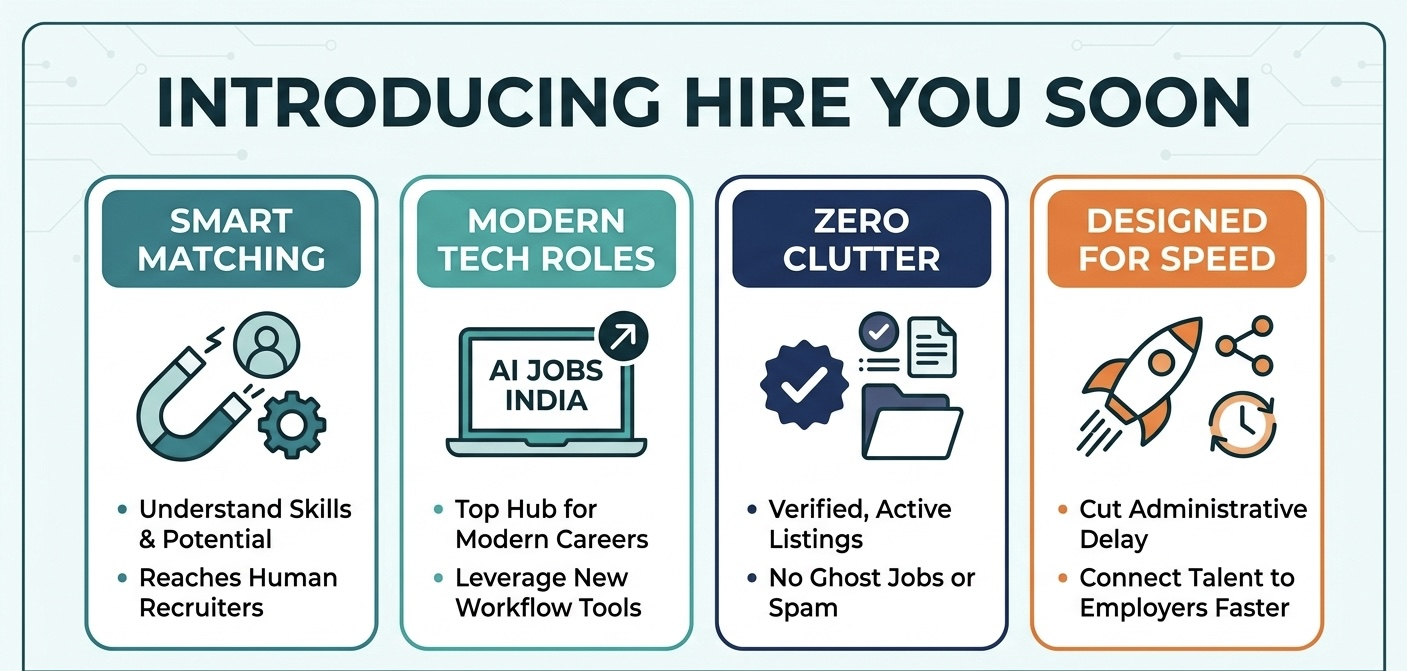
In a world shaped by rapid technological advances, you cannot rely on slow, outdated career platforms. This is where Hire You Soon stands head and shoulders above every other job portal in the market.
While traditional sites leave your profile buried under millions of inactive listings, Hire You Soon uses smart, cutting-edge matching technology designed for today’s dynamic job market. It bridges the gap between ambitious professionals and forward-thinking companies that are leading the tech evolution.
The rise of artificial intelligence is not something to fear. It is a powerful tool reshaping our world. When evaluating whether ai in jobs threat or opportunity represents the true reality, the answer depends entirely on your readiness to adapt. By embracing tools like an AI chatbot, understanding the shifting market dynamics, and tracking industry innovators like OpenAI, you can transform this technological wave into the biggest launchpad for your career. Do not let your talent get lost in obsolete databases on traditional websites. Pair your modern skills with a modern career vehicle. Head over to Hire You Soon today, set up your premium profile, and land your dream job in an evolving market. The future is waiting for you—make sure you’re ready to seize it!
I am Aysha, Business Development Executive at Soonsoft Software Solutions Pvt Ltd, where I lead strategic initiatives to bridge the gap between academia and the corporate world. My work is centered on the expansion of the "Hire You Soon" portal, ensuring that educational institutions and industry leaders can connect through a seamless, verified recruitment ecosystem. With a focus on institutional relationship management and market growth, I am dedicated to creating high-trust talent pipelines that empower the next generation of professionals.
 Aysha
Aysha  Aysha
Aysha  Aysha
Aysha 
 Aysha
Aysha  Aysha
Aysha