
Looking for the Best Career Portal in India? Here’s Why Candidates Pick Hire You Soon Portal First
 Fathima Syed
September 1, 2026

 Fathima Syed
 April 25, 2026
 8 mins to read
The transition from the lecture hall to the office cubicle (or the remote workstation) has never been more dynamic. As we navigate 2026, the landscape of fresher hiring has shifted from a standardized “grades-first” approach to a nuanced, multi-dimensional evaluation of potential.
For many graduates, the big question remains: What do employers actually want? The answer is no longer found just in the name of your university or your GPA. Instead, it lies in a blend of digital fluency, adaptability, and a shift toward skill-based hiring.
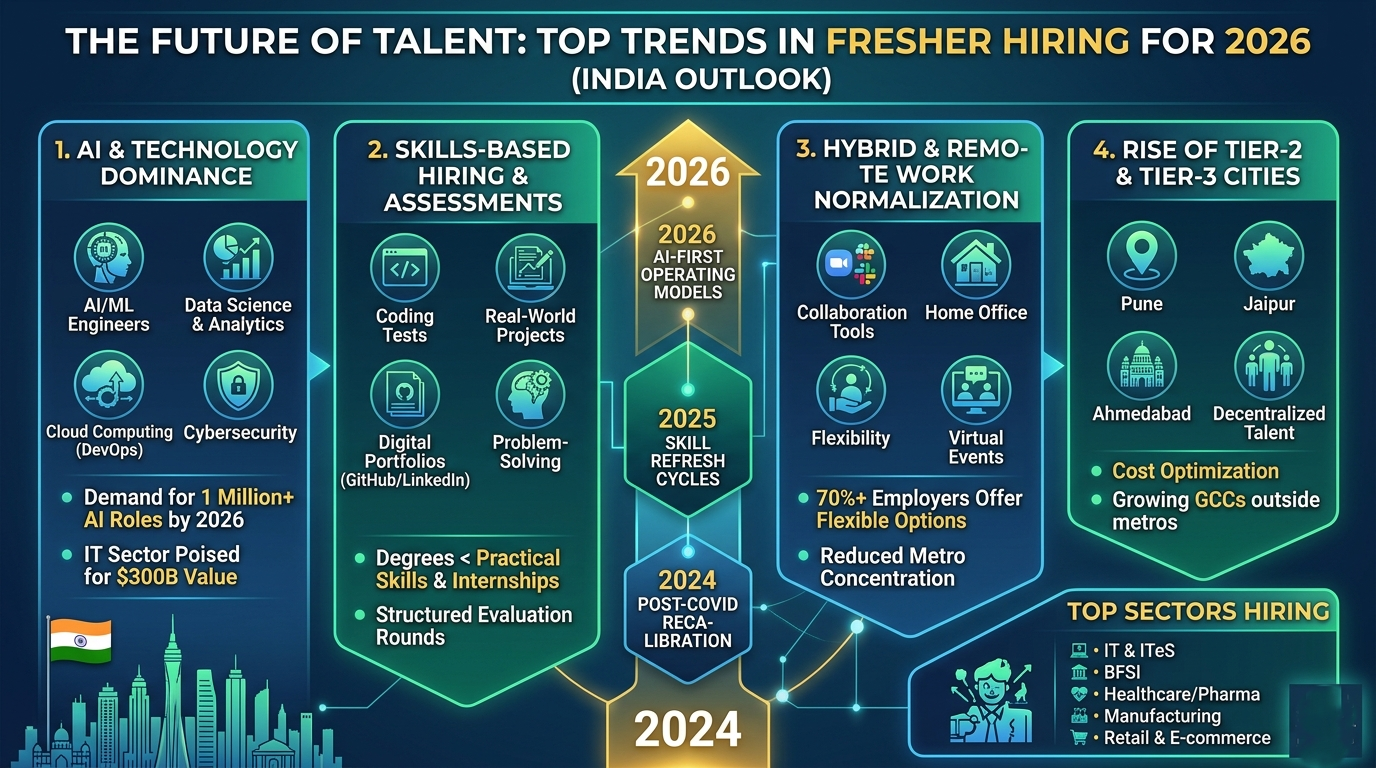
For decades, recruitment was a game of “pedigree.” If you came from a top-tier institution, your resume went to the top of the pile. Today, that hierarchy is collapsing.
Employers are realizing that a prestigious degree doesn’t always equate to job readiness. We are seeing a massive surge in skill-based hiring, where the primary metric for selection is what a candidate can do, rather than where they studied. This democratizes the process, allowing talented individuals from diverse backgrounds to compete for high-value roles.
Why the Shift?
It is impossible to discuss fresher hiring without mentioning Artificial Intelligence. However, the trend isn’t just about knowing how to code an AI; it’s about knowing how to collaborate with one.
Employers in 2026 are looking for “AI-augmented” employees. This means:
As technical tasks become increasingly automated, the “human” element becomes a premium commodity. In the current fresher hiring cycle, soft skills are being rebranded as “power skills.”
The Top Four Power Skills:
The traditional four-year degree is being supplemented (and sometimes replaced) by micro-credentials. In the world of skill-based hiring, a specialized certification in Data Analytics, Cybersecurity, or Digital Marketing can often carry as much weight as a minor degree.
Employers are looking for “T-shaped” individuals: those who have a broad base of general knowledge but deep expertise in one specific, marketable skill.
The old-school trend was “Cultural Fit”—finding someone who blends in perfectly with the existing team. The 2026 trend is “Cultural Add.”
Modern fresher hiring strategies seek candidates who bring a new perspective, a different life experience, or a unique way of thinking that the current team lacks. Employers want freshers who can challenge the status quo rather than just nodding along.
The resume is not dead, but it is no longer the star of the show. Employers now demand a “Proof of Work.”
In skill-based hiring, showing a project you built from scratch is infinitely more persuasive than listing a “Proficient in Python” bullet point.
Gen Z and the emerging Gen Alpha are known for their values-driven approach to work. Interestingly, employers are now looking for this trait in fresher hiring.
Companies are under immense pressure to meet ESG (Environmental, Social, and Governance) goals. They look for candidates who understand sustainability, who practice ethical decision-making, and who want to contribute to the company’s social impact footprint.
If you are applying for a role today, don’t be surprised if your first “interview” is a game.
Recruiters are using neuro-assessment games to test a candidate’s risk appetite, memory, and attention to detail. This is a core component of skill-based hiring because it removes human bias from the initial screening phase, focusing purely on cognitive data.
The post-pandemic world has been volatile. Employers are specifically looking for “Resilience” as a core competency. They want to see how you handled a setback during your studies or how you navigated a difficult project. Highlighting a “successful failure”—where you failed but learned a critical lesson—is a powerful strategy in modern fresher hiring.
The distinction between an intern and a full-time employee is blurring. Most fresher hiring now happens through “Pre-Placement Offers” (PPOs). Employers use 3-to-6-month internships as a live trial to witness skill-based hiring in action. If you can prove your value during an internship, the paperwork for a full-time role becomes a mere formality.
The world of fresher hiring in 2026 is no longer a monolith. It is a vibrant, fast-moving ecosystem that prizes agility over tradition. While academic excellence still provides a foundation, it is your specific, verifiable abilities that will get you through the door.
By focusing on skill-based hiring—building a portfolio, mastering AI collaboration, and honing your “power skills”—you position yourself not just as a graduate looking for a job, but as a high-value asset that modern employers are desperate to recruit.
The key is simple: Stop trying to “fit” the mold and start showing how you can “add” to the mission. The future belongs to those who keep learning.
NB: India’s Emerging Job for Freshers
More Info : Fresher Hiring trends according to the 2026 report from Time Of India
I am Fathima Syed, and I’ve spent over a decade decoding the logic behind the search bar to help stories find their audience. My journey began with a simple curiosity about why some voices dominate the digital landscape while others remain virtually invisible. By blending technical precision with creative narrative, I transform complex algorithms into actionable strategies for growth. I believe that true SEO isn't about "gaming the system," but about being the most helpful answer to a user’s question. My writing serves as a bridge between the mechanical requirements of search engines and the emotional needs of human readers. Today, I continue to explore how emerging technologies can be harnessed to ensure that meaningful content never gets lost in the noise.
 Fathima Syed
 Fathima Syed
 Fathima Syed
 Fathima Syed
 Fathima Syed
 Fathima SyedFathima Syed
 Fathima Syed
 Fathima Syed